

Sarah Dickinson
17 May 2017
Ubuntu ranked as 2nd most used IoT OS by Eclipse Foundation survey
Last week we posted a blog on programming languages following the Eclipse Foundation 2017 IoT survey results. This week we look at the findings from a business perspective which highlight a number of IoT trends emerging from the wide ranging survey from key industries, growth of new technologies, most common concerns and more. The 2017 results garnered a total of 713 respondents, from all over the world, providing their views on how they are building and using IoT solutions today.
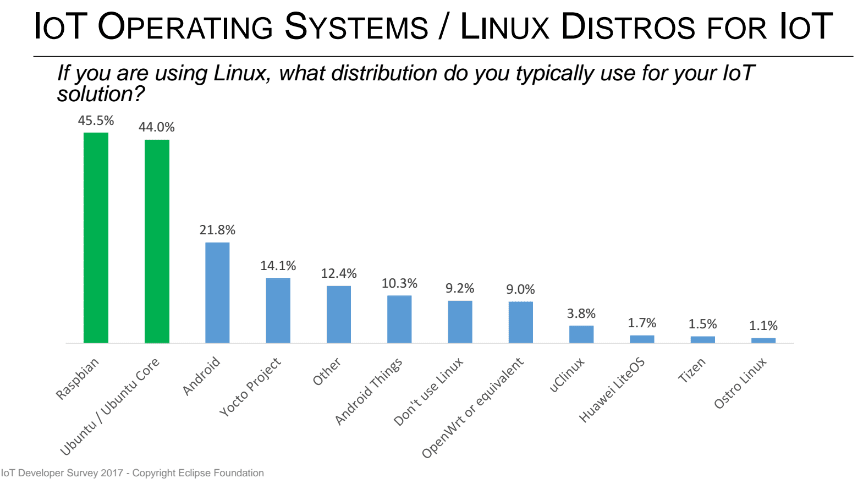
When it comes to building IoT solutions, Linux continues to be the main operating system for both IoT gateways (66.9%) and on constrained devices (44.1%). Taking both these into account, Ubuntu and Ubuntu Core are being used by 44% of those using Linux and far ahead of many alternative operating systems. Designed especially for IoT applications, and trusted by chipset vendors to device makers and system integrators, it’s encouraging to see such a high adoption rate for Ubuntu Core. Those that weren’t using Linux as their chosen OS for IoT were in fact most likely to be using a bare metal solution instead.
More positives for the open source world found that 46.1% of organisations use this in their IoT solutions, with a further 49.1% having either experimented with it or a committer on such a project for building IoT solutions. This demonstrates the fact open source within the embedded space is not feared and is seen as the best way to deliver projects especially when fast development times are expected.
Looking at broader topics that the survey covered revealed that the top 5 IoT industries saw significant growth from three areas in particular; smart cities, energy management and industrial automation. Although home automation and IoT platforms remained in the top 5 just as they did in 2016, it provides further evidence that IoT is spreading across verticals with an increasing number of sectors looking to integrate and benefit from it.
Inevitably security remains the key concern that IoT developers face, followed by interoperability and connectivity. Interestingly, interoperability was deemed less of a concern than both the 2015 and 2016 surveys indicating that the increase in number and influence of IoT consortiums is starting to have a positive effect. The Eclipse Foundation and IEEE were seen as the top two most important to those organisations who responded. Efforts to create standardisation in the industry such as the introduction of snaps, a universal Linux packaging format, may also be a factor in the lower interoperability concerns highlighted in 2017.
Many of the findings of the 2017 survey correlate with other industry reports showing a consistent theme across the board. Although IoT continues to evolve at a fast rate, this survey confirms that many of the concerns remain the same regardless of industry and all those in the IoT ecosystem should continue to collaborate to help overcomes these challenges.
The full results can be viewed here, or the key findings are summarised here.


